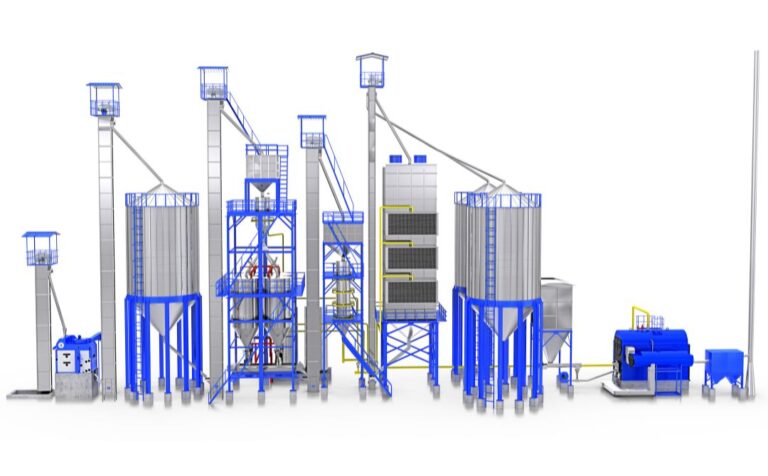
A 150-TPD rice mill in Punjab’s Sangrur district now runs with just nine people on the floor instead of the earlier 85. No worker climbs soaking tanks, no one stands for hours feeding paddy into the boiler, and the head-rice recovery has jumped from 64 % to 70.5 % — all because the owner switched to a fully automated paddy processing plant in 2023.
This is not an isolated success story. From Telangana to West Bengal, the next decade of Indian rice milling will belong to plants where machines talk to machines, decisions happen in milliseconds, and human hands touch paddy only at the packing stage.
Key Technologies Powering the Automated Revolution
PLC-SCADA systems that control every motor, valve and conveyor from a single touchscreen
IoT-enabled sensors for moisture, temperature, grain colour, and flow rate
Variable-frequency drives (VFD) on blowers, elevators and pumps for precise energy use
Robotic pneumatic valves and diverters that route paddy automatically between sections
Cloud-connected dashboards accessible on phone from anywhere in the world
Combined, these technologies have turned a rice mill from a collection of independent machines into one living, thinking organism.
How Automation Directly Improves Yield, Quality and Efficiency
Automation removes the biggest enemy of rice quality — human inconsistency.
Soaking tanks maintain exact water temperature (±0.5 °C) and automatic water-exchange cycles, delivering perfect gelatinization every single batch.
Continuous online cookers with PLC-controlled steam injection eliminate under-cooking or over-cooking that used to create white-belly grains.
In-line moisture sensors after every dryer stage instantly adjust air volume and temperature, preventing case-hardening and cracks.
Colour sorters and thickness graders automatically divert off-spec grains into separate silos instead of mixing them back.
Result: head-rice recovery rises 4–7 %, broken percentage drops below 10 %, and cooking characteristics become identical bag after bag. Buyers pay ₹400–₹800 extra per quintal for this consistency.
The Real Cost Equation: Automated vs Traditional Plants
Many mill owners fear automation is expensive. The numbers tell a different story.
In reality, the numbers work strongly in favour of automated plants once the full picture is considered. A traditional 100-TPD plant typically costs ₹9–11 crore to set up and requires 80–90 workers round the clock, pushing annual salary expenses to ₹3.5–4 crore. Power consumption is also higher by 18–22 % because motors run at fixed speeds and manual interventions waste energy.
In contrast, a fully automated 100-TPD plant comes in at ₹14–20 crore but needs only 12–18 people in total, bringing yearly manpower cost down to ₹70–90 lakh. Variable-frequency drives and sensors optimise electricity usage across the board. Most importantly, the higher capital is quickly offset by an additional 5–6 % recovery, which translates into ₹3–4 crore extra revenue every year at current prices.
After accounting for lower power bills and labour savings are added, the additional investment usually pays itself back in 22–30 months. From the third year onward, the automated plant puts ₹4–5 crore more into the owner’s pocket annually compared to a traditional setup.
After the third year, an automated plant saves ₹4–5 crore annually in labour, power and higher sale value. Most SKF Elixer automated plants commissioned in 2020–21 have already recovered the extra investment.
Smart Sensors and Real-Time Monitoring in Parboiling & Drying
The heart of modern paddy parboiling plants is the sensor network:
Capacitive moisture sensors inside soaking tanks trigger water change when moisture reaches 30–32 %
Infrared temperature guns on steaming vessels maintain 98–102 °C surface temperature
Load cells under every silo show exact inventory in kilograms on the SCADA screen
Grain temperature probes inside dryers activate cooling cycles automatically
CCTV + AI cameras count broken percentage on conveyor belts in real time
Owners now receive WhatsApp alerts if soaking water temperature drifts by 2 °C or if dryer outlet moisture crosses 14.5 %. One miller in Burdwan prevented a ₹28-lakh loss last season when his phone buzzed at 2 a.m. about a stuck pneumatic valve — he restarted it remotely in four minutes.
Overcoming the Challenges of Automation in India
No transformation is frictionless. The four biggest hurdles mill owners face — and their practical solutions — are:
High initial cost → Solved by 35–50 % subsidy under PMFME, SMAM and state schemes + low-interest priority-sector loans.
Skilled manpower shortage → New plants come with two-year AMC that includes remote monitoring by the manufacturer. Basic training of local ITI electricians is enough.
Unreliable power supply → Most automated plants run critical sections on VFDs that tolerate ±15 % voltage fluctuation. Many install rooftop solar + battery backup for PLC and sensors.
Fear of frequent breakdowns → Stainless-steel construction, in-house manufactured components, and predictive maintenance through vibration & temperature sensors have increased MTBF (mean time between failures) beyond 9,000 hours in SKF Elixer plants.
The Road Ahead
By 2030, industry estimates suggest over 40 % of India’s 1,50,000+ rice mills will be at least semi-automated, and 8,000–10,000 will run fully automated lines. The trigger will be simple economics: when labour cost crosses ₹600–₹700 per day and buyers refuse to pay for inconsistent quality, automation stops being an option and becomes survival.
Companies like SKF Elixer are already delivering sixth-generation automated plants.
Conclusion
The future of paddy processing in India is not about bigger mills — it is about smarter ones. Fully automated plants are turning rice milling from a labour-heavy, weather-dependent gamble into a predictable, high-margin, round-the-year industry.
They are creating mills that run 330 days a year with half the people, double the profit, and quality that commands premium prices in the world’s toughest markets.
The mill owners who embrace paddy processing automation today will not just survive the next decade — they will define it.
Frequently Asked Questions (FAQs)
1. How many people are actually required to run a 100-TPD fully automated plant?
12–18 persons total (including security & packing). The core process needs only 4–5 skilled operators per shift.
2. Will automation completely eliminate the need for experienced mill workers?
No. It shifts their role from manual labour to supervision, data monitoring and maintenance — higher skill, better pay, safer work.
3. Can existing old mills be upgraded to automation?
Yes. Most automation packages can be retrofitted in phases — starting with parboiling & drying, then adding sorting and packing.
4. What is the biggest single benefit owners report after automation?
Consistency. Same head-rice percentage and cooking quality every single day, regardless of season or labour attendance.
5. How long does it take to install a fully automated 100-TPD plant?
From foundation to trial run: 8–10 months for a greenfield project, 5–6 months for brownfield upgradation.